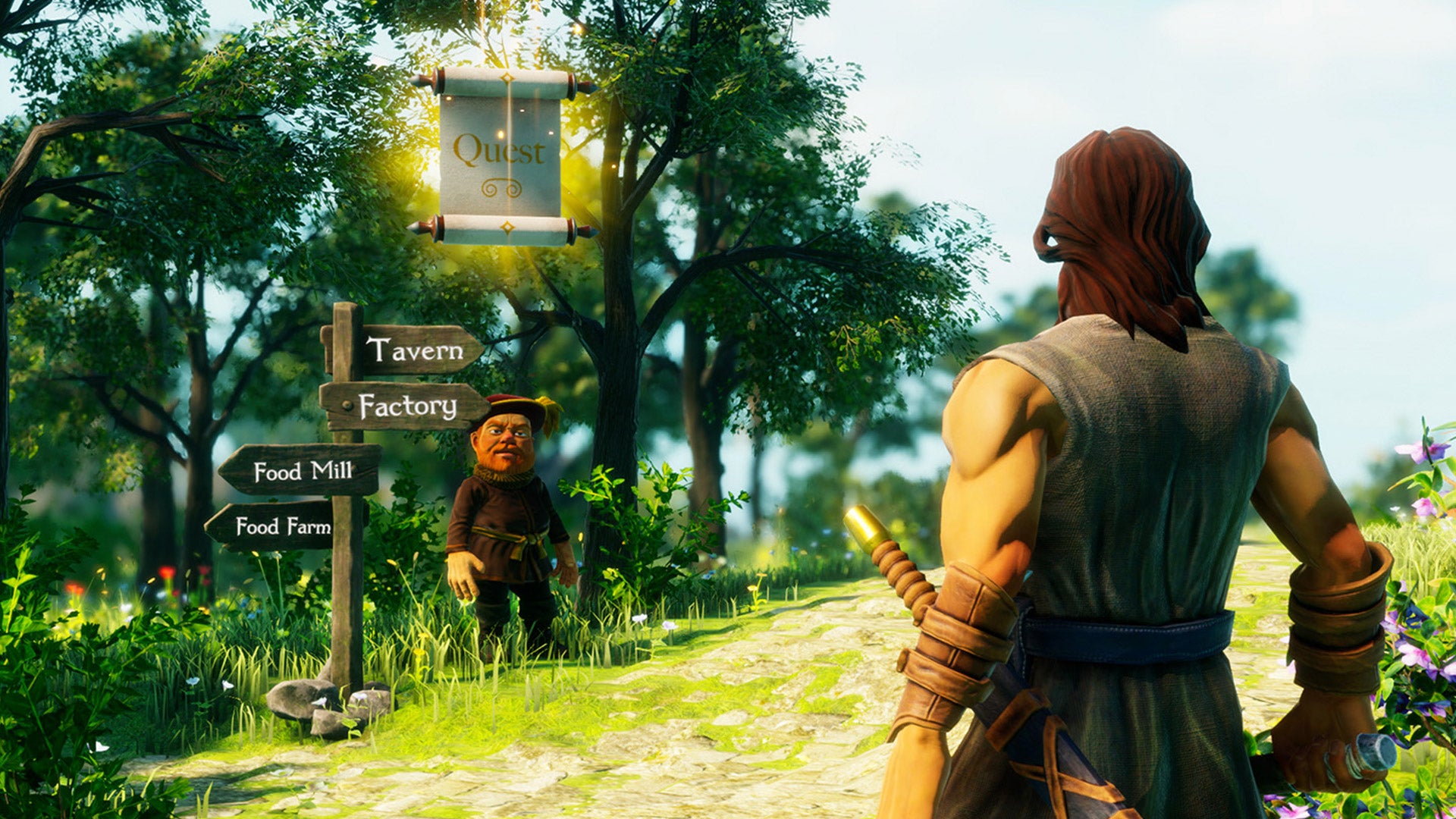

“It’s all allowing players that freedom,” says Peter Molyneux. “And that’s what we’ve been exploring with Masters of Albion.”
The god game thrives on freedom, and, arguably, is nothing without it. No one knows that better than Peter Molyneux. The lead developer of landmark god games such as Dungeon Keeper, Populous, and Black & White, he’s returning to those roots after years away with Masters of Albion, a self-declared “culmination” of all his work to date that blends those god game greats with other milestones from a long career that also birthed Fable.
Freedom very much is the word I heard most often when speaking with Molyneux recently. His upcoming project, developed at his studio 22Cans, is not only inspired by his own vaunted library, but also by modern masterpieces that have reframed our understanding of player freedom.
“I look at the true greats, things like Breath of the Wild and Tears of the Kingdom”, Molyneux reveals. “I wouldn’t dare to say that our games are anywhere close to as good as those games, but I’m inspired by the fluidity, the seamlessness of those experiences. You’re not going through level-up screens. It is just seamless. I’m really inspired by that.”
The latest two Zelda games are heralded for how reactive their versions of Hyrule are, and how their systems beg to be experimented with. You can see a similar ambition in the latest gameplay trailer for Masters of Albion, which showcases the numerous ways you can interact with the world of Albion. You can approach from many different perspectives, from the more traditional city building and infrastructure management layer, to RPG-esque missions full of sword and shield combat, to running the rule over its open world via a massive hand that floats over your townspeople as if The Addams Family’s Thing has risen to deity status.
“The hand really is the star of the show”, says Molyneux. “Giving players the ability to reach into a world, to manipulate things, to move things around, to combine things in ways that we may have never thought of is incredibly alluring for me and really fascinating to experiment with. And the interesting thing is, the more we develop this idea and the more we create it, the more other ideas come around the hand. There are some real surprises in that thing.”
The hand, of course, has played a starring role in Molyneux’s Black & White games, but revisiting the concept has allowed 22cans to add a number of new surprises. Among them, I’m teased, is the ability to contort its four fingers, thumb, and palm into whichever shape you choose, and each and every occupant of Albion will react expressively to that. I’m not saying that you might want to raise only your middle digit up when confronting a tiny person who refuses to behave the way you’d like them to, but you do really want to, don’t you?
There are other, more playful ways to annoy your devoted townsfolk. Want to make a laughing stock of one of your villagers? Then have him parade around the streets dressed in armour made of sausages, created through the detailed factory system that allows you to substitute chainlink for chains of pork. This playfulness and sense of humour are things we’ve come to expect from Molyneux’s games, but crucially, all of these quirks play into Masters of Albion’s world systems, too.
Not only a flicking off device, the hand also plays into the surprisingly deep city-building side of things. This isn’t your standard “drop a mine near a valuable source of ore” situation, but one that lets you express yourself in the architectural design and colour of your buildings. While a snap-together block building system allows you to create towers and factories and housing complexes of your own design, be aware that your arrangements have consequences, including shifting your moral alignment — something familiar to any fan of the Black & White series. But there will also be other, more surprising consequences that evoke the odd systems of Lionhead’s Fable days, such as the rather ominous-sounding arrival of a housing inspector…
Molyneux explains that choices like colour and shape can cause a property inspection, and while he’s careful not to spoil the consequences of a failing grade, it sounds like something worth avoiding.
”You want to be careful that you don’t trigger the housing inspector, because when [he] comes and he doesn’t like that you’ve created a slum where everyone’s packed together… he does not like that sort of stuff,” he teases.
While things like the housing inspector will take time to occur in-world, Molyneux also wants to ensure that there’s instantaneous fun to be found in designing towns and individual buildings. He’s doing away with the genre staple construction timers, instead getting straight into the buffs and nerfs each new block might bring.
“I love playing city-building games, but I always get frustrated that I have to build a mine here and that’s it,” Molyneux states, clearly frustrated by the time spent waiting for resources to start flowing. “[In Masters of Albion] you can build anything you want, anywhere you want, and it works immediately. There are no wait timers. If you’ve got a farm and you’ve got a mill and you’ve got a factory, you can say, ‘I’m just going to put them all into one building’ and you can make this thing that looks like Howl’s Moving Castle with all these workstations for your workers, and it will work as you are building it. You don’t have to wait for bricks to come to build it. I really want it to feel more like Lego than anything else, that immediacy of what you are building.
Like Howl’s Moving Castle, there’s nothing rooting you to the spot. “You could go back to your original town, which is Oakridge, and you could say, ‘Do you know what? I’m going to move the whole of Oakridge to Wyrmscar, so I’m going to have everyone live in Wyrmscar.’ So this all comes back to god games being about freedom.”
But that freedom also needs direction, and that’s where Masters of Albion’s story comes into play. Launching into early access on April 22 will be chapter one of a planned trilogy, for which a full “epic” story is planned. While tales will play out in the world as you (literally) build it by hand, it appears the main thrust of its narrative structure can be found when Masters of Albion morphs more into a Fable-like shape, as you possess its heroes and venture out on RPG-like quests, slashing enemies down with a sword or turning them to dust with magic.
“One of the things that we haven’t done a good job of explaining is that there is a narrative story”, admits Molyneux. “It’s a huge epic story that winds through the entirety of the game. You saw a couple of times in the gameplay trailer that when the gold scroll was clicked on, that’s a quest. If it’s a gold scroll, it’s on the golden line. It’s a story quest. If it’s a silver scroll, it’s an optional quest.
“And all those quests, they give you more stuff”, he continues. “They may give you one of the currencies in the game, they may give you more blocks that you can build with, they may give you more parts that you can design things with.
“You’d be travelling through a land in Fable, and you’d see a chest, and you go and open that chest,” Molyneux explains. “We’ve got that in here. You can go and open a chest just like in Fable, you can stumble upon a scene that is playing out, and you can get involved in that scene. And so we’ve been inspired by the open-world nature of Fable 2 and Fable 3.”
Masters of Albion does sound ambitious, but ambition is something we’ve learned to take as a given from Molyneux’s work over the years. Whether these many complex, intertwining systems all come together and work in harmony is, of course, yet to be seen. I’m hopeful, though, because without big swings like Masters of Albion, genres such as the god game would be left to stagnate. That’s something Molyneux is highly aware of, due to the complex nature of their conception.
“It’s very hard, in my experience, to sit down and say, ‘Right, I’m going to design a god game.’ Because so much of it is the visceral feeling of connecting these gameplay systems together. It is a very frightening design process that you’d think, ‘Oh, I wish I could just make a first-person shooter. I know what a first-person shooter is.’ It’s a terrifying development process to make a god game.”
Masters of Albion will be released into early access on April 22, 2026, and is available to wishlist now on Steam. For more, check out how 22Cans plans for Masters of Albion to be a trilogy, and Molyneux’s emotional reaction to watching the gameplay reveal of Playground Games’ upcoming Fable.
Simon Cardy is a Senior Editor at IGN who can mainly be found skulking around open world games, indulging in Korean cinema, or despairing at the state of Tottenham Hotspur and the New York Jets. Follow him on Bluesky at @cardy.bsky.social.

Leave a Reply