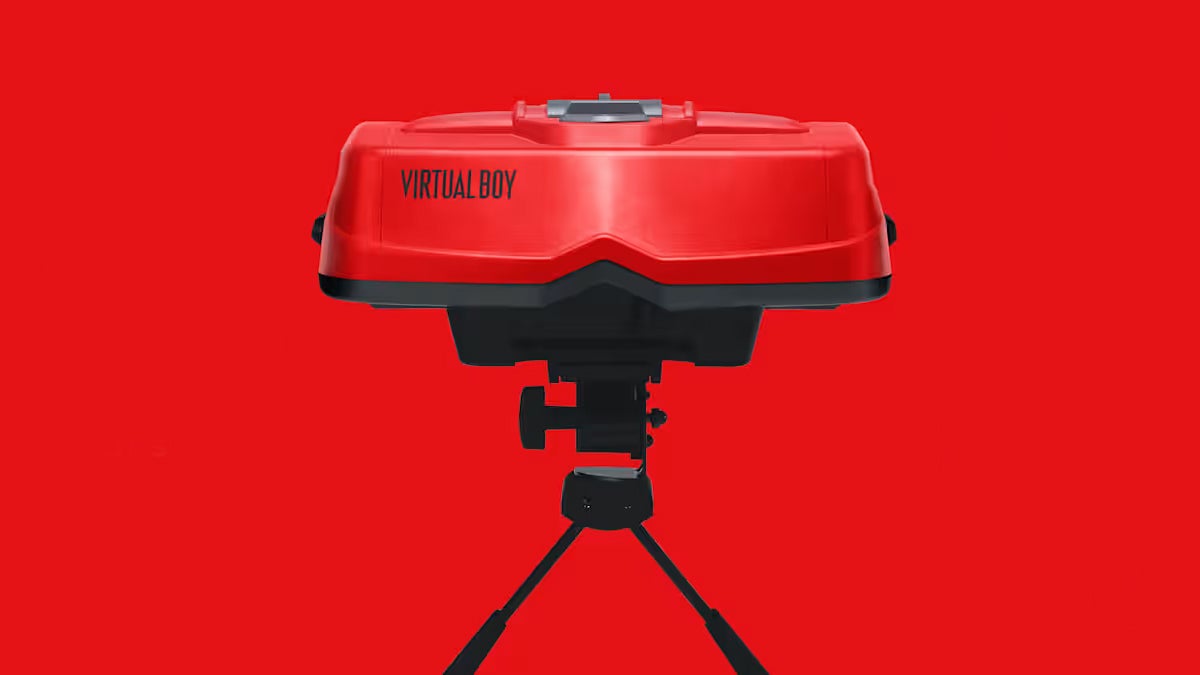

A big sign of emotional maturity is owning up to your most embarrassing failures. For Nintendo, that past mistake is the Virtual Boy, and for the better part of three decades, the company has mostly ignored its most iconic commercial and critical fiasco, likely hoping we’d all just forget they ever released a tabletop headset that was known for causing splitting headaches and eyestrain with its limited red and black 3D graphics. Nintendo has never rereleased any of the Virtual Boy’s comically small library of just 22 games (several of which were exclusive to Japan), even when they launched a stereoscopic 3D handheld that would have been the perfect emulator. But 30 years later, Nintendo is finally ready to reminisce and poke some fun at this ridiculous footnote by bringing Virtual Boy to Switch 2 and Switch, complete with a very faithful (and expensive) accessory that recreates the original look and feel. And after playing several games that will be available in the launch lineup on February 17, I’m thrilled to finally be able to discover this lost corner of Nintendo history, even if there aren’t very many games to dive into.
Even though they’re finally bringing some of these lost games back, Nintendo still isn’t making it very easy to access them. Virtual Boy – Nintendo Classics will be available for Nintendo Switch Online + Expansion Pack subscribers (that’s the more expensive tier that costs $49.99 annually for an individual membership here in the U.S.), and you’ll also need one of two accessories sold through Nintendo’s website to play them. The first choice is the $100 replica of the original hardware, and the second is a $25 cardboard model you hold up to your face like Nintendo’s experimental Labo VR set. You can slide your Switch or Switch 2 into either of these hollow models to supply the screen, and according to the fine print of the latest Virtual Boy trailer, you can only play these games with one of these two accessories – you can’t play them regularly in handheld mode or on your TV. The forgiving view of this decision is that Nintendo aims to preserve the original Virtual Boy experience as closely as possible, while the cynical view is that Nintendo just wants to squeeze more money out of its most hardcore fans for a silly novelty that probably won’t actually provide much playtime. The truth is probably somewhere in the middle of those two extremes.
I only saw the cardboard version behind a glass case, but I did get to go hands-on with the replica and instantly fell in love. I pride myself on having played most games from across Nintendo’s entire history, but the Virtual Boy has always been a big red-and-black hole in my library. Secondhand Virtual Boys and game cartridges are simply too expensive, so I’ve never pulled the trigger even if I’ve been tempted several times by various Facebook Marketplace listings, always stopping short when I see the previous owner wrote their name on all their cartridges in permanent marker. So as a hardcore Nintendo enthusiast who enjoys learning about both the good and the bad of their history (and talking about it every week on Nintendo Voice Chat, IGN’s all-Nintendo podcast), I’m the exact target audience for this bonkers release.
The unit itself is really high quality. The headset rests on a two-legged stand with a knob you turn to adjust the viewing angle. If you squint or see it from a distance, you’d be forgiven for thinking it was an authentic Virtual Boy. The design is undeniably weird and cool, and I can’t wait to display it in my office. I sat down, looked through the red lenses, and saw the monochrome display staring right back at me. I wear glasses, so often when I try on VR headsets a bit of light bleeds through the sides, but the Virtual Boy’s rubber eye shade was big enough to completely block out 2026 and let me immerse myself entirely in 1996.
Seeing Red
I first dove into Wario Land, one of seven games included in the launch lineup and the game I’ve easily heard the best things about over the years. After just one level, I can see why it has a strong reputation. Apart from the lack of a varied color palette, it looked and played just like the classic Wario Land games, with Wario’s aggressive dash attacks and destructive platforming. This is a sidescroller, but it makes use of the stereoscopic 3D with obstacles like swinging iron balls that move toward and away from you, where the added depth helps you judge their location. Having never played Virtual Boy before, seeing Nintendo games in 3D again made me oddly nostalgic for early 3DS games that made good use of the 3D slider, like Super Mario 3D Land. Wario Land made use of the feature in its platforming, too, with segments that launched Wario into the foreground and background, an idea used a lot in platformers we’d get later like Mutant Mudds, Kirby Triple Deluxe, and Donkey Kong Country Returns. After Wario Land, I hopped around some of the rest of the launch lineup, including Golf and the Punch-Out!!-like Teleroboxer.
I only played for about 20 minutes, but I thankfully didn’t get a headache like the original hardware’s reputation would suggest. I’m honestly not sure how long I’ll play in one sitting when my own Virtual Boy preorder shows up in a couple weeks, because even though Wario Land was fun, it’s still kind of a pain to play. The edges of the screen were tough to see when looking in the unit, and it’s not the most comfortable feeling to crane your neck to look inside. At least it’s that authentic neck pain I’ve always wanted, though.
Would I recommend the average Nintendo fan drops $100 or even $25 to play these games? No, probably not. There are only seven of them to play at launch, and they are more enjoyable from a historical perspective than an entertainment one. You could buy seven superior indie games for 100 bucks that come in more than just one color. But if you love exploring wacky bygones from past eras and want a really cool accessory to display in your game room, you’ll probably really like the new Virtual Boy like I did. And there are more games coming after launch, including a previously unreleased F-Zero spinoff called Zero Racers, which is unbelievably exciting as an F-Zero superfan.
I walked away not sure which is crazier: the fact that Nintendo made this bizarre piece of hardware 30 years ago, or the fact that they are rereleasing it now. The Virtual Boy sold roughly 750,000 units worldwide, and I’m not sure the market for this retro rerelease is much larger than that. It’s incredibly niche, pretty expensive, and there are only a handful of games worth playing, but they still chose to bring it back. And that’s one reason I love covering Nintendo; they’re the crazy toymaker of the video game industry. Not every swing they take is a smash hit, and I’m so excited to finally learn everything about one of their worst misses.
I played a lot more at the Nintendo preview event last week besides the Virtual Boy. Check out my previews of Mario Tennis Fever, Resident Evil Requiem’s excellent Switch 2 version, and why I’m tired of Nintendo Switch 2 Editions after playing Super Mario Bros. Wonder’s new content.
Logan Plant is the host of Nintendo Voice Chat and IGN’s Database Manager & Playlist Editor. The Legend of Zelda is his favorite video game franchise of all time, and he is patiently awaiting the day Nintendo announces a brand new F-Zero. You can find new episodes of NVC every Friday on the IGN Games YouTube channel, Apple Podcasts, Spotify, or your favorite podcast app.

Leave a Reply